
Building the Web3 Anonymous Chat Stack: How Peer-to-Peer Protocols Replace Servers
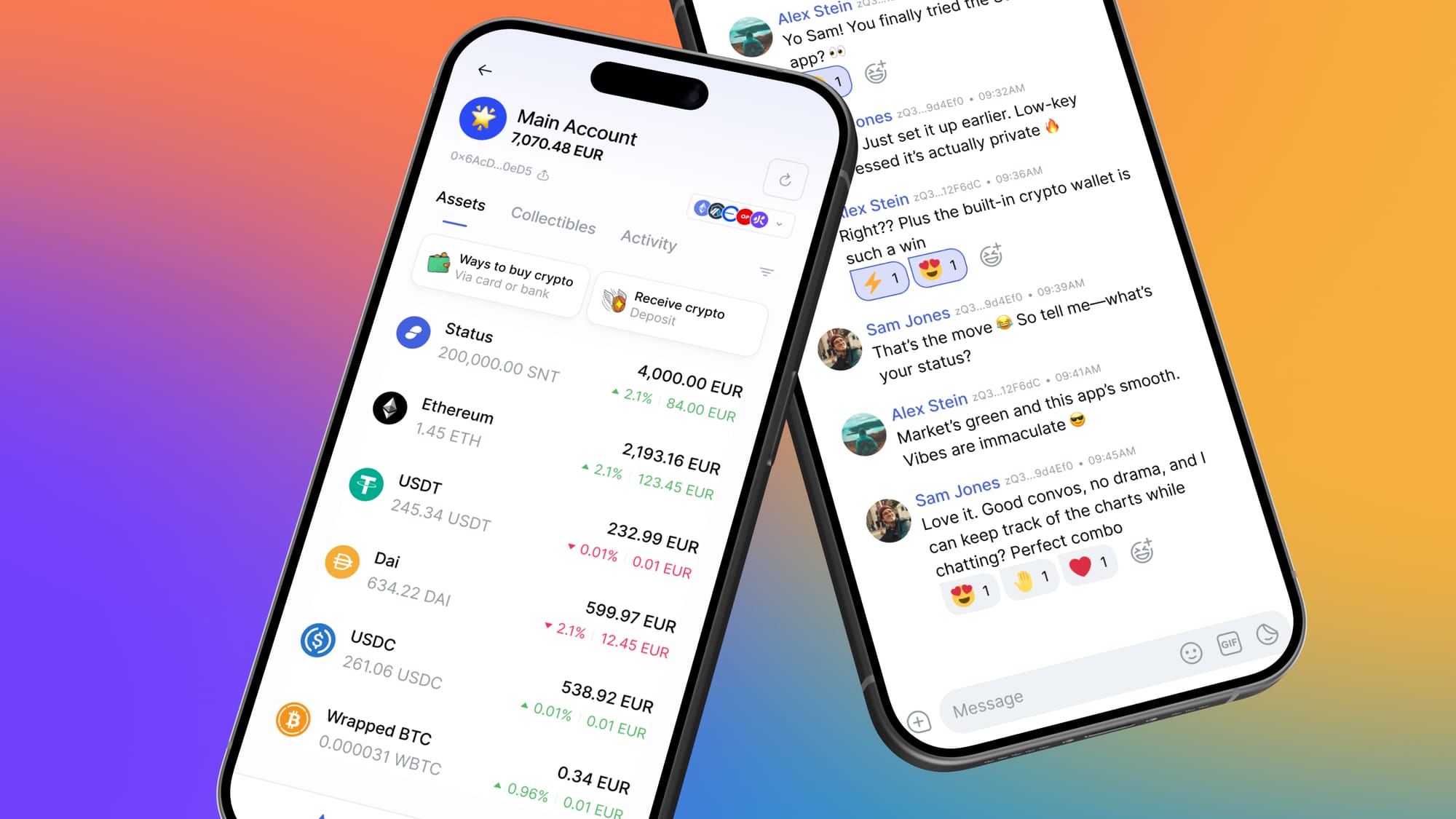
Centralized messaging platforms route every message through corporate servers, exposing metadata such as sender identity, recipient, timestamp, and IP address to a single operator. An anonymous chat app web3 architecture eliminates that single point of surveillance by distributing message relay across a peer-to-peer network. Status App implements this architecture using Logos Messaging (formerly Waku), end-to-end encryption, and anonymous identity generated via cryptographic key pair with no phone number or email required at onboarding.
Traditional messengers depend on a server to authenticate users, store, queue, and route messages. Even when end-to-end encryption protects message content, the server still observes who talks to whom and when. This metadata is valuable to advertisers, governments, and attackers.
The core vulnerability is structural. A single operator controls the storage and routing layer. Therefore, any legal order, data breach, or internal policy change can expose the social graph of every user on the platform.
| Metadata Point | Centralized Server Exposure | Peer-to-Peer Exposure |
|---|---|---|
| Sender identity | Known via account registration | No registration; anonymous identity generated via cryptographic key-pair |
| Recipient identity | Known via message routing | Obscured by topic-based peer to peer relays |
| Message timestamp | Logged server-side | Relay nodes see encrypted payloads |
| IP address | Captured at connection to centralized servers | Visible only to connected peers |
Logos Messaging (formerly Waku) is the peer-to-peer messaging protocol that Status App uses for all message transport. Instead of sending a message to a corporate server, Status publishes an encrypted payload to a content topic on the Logos Messaging (formerly Waku) network. Relay nodes (Status Desktop clients) propagate that payload without decrypting it. Furthermore, decrypting is not even possible by relay nodes, because encryption keys are only available to chat participants. The recipient's device subscribes to the same topic and decrypts locally using its private key.
Each conversation, whether one-to-one or inside Status Communities, maps to a content topic. Relay nodes forward all encrypted messages matching a topic without any knowledge of or access to message content.
Status App routes all messages through the Logos Messaging (formerly Waku) peer-to-peer network, so no centralized server ever has access to message content or metadata .
Nodes in Logos Messaging network can support Store protocol, such nodes cache all encrypted messages in the network and allow other nodes to query the messages in certain time period for the given content topic of interest. On reconnection, Status App queries a store node for messages in topics of interest during the offline period and decrypts them locally on their device and with their private key. The store operates with encrypted messages and has no knowledge or possession of any decryption keys.
Status App does not use a centralized backend. Instead, the native backend called Status backend fully resides and runs directly on user's device. It manages cryptographic keys, protocol negotiation, and local database storage.
- Key management: Cryptographic keys are stored on the user’s device disk in an encrypted keystore and database, both protected using the user’s password. Without the password, the stored keys remain inaccessible.
- Process separation on Android: The UI and status-go run in separate Android processes. They communicate through Android-native Binder (AIDL) IPC. This ensures that messaging and decryption survive and keep running when app is closed.
- Privacy-driven notifications: Status delivers notifications via its on-device background service, with no third parties, centralized servers, or intermediaries involved.
Status App generates a cryptographic key pair during onboarding. No phone number, email, or government ID is required. The chat key serves as the user's anonymous identity. Users can optionally register a human-readable name in ENS and bind it to Status identity.
This design has a direct consequence: there is no central user directory to subpoena. Discovery happens through sharing chat keys or ENS names directly between parties.
For hardware-level key protection, Keycard can be used to store Status keys on an isolated secure element. This moves key material off the phone's general-purpose processor, reducing the attack surface to a physical card that the user controls.
Status App uses only a cryptographic key pair for account creation, so no central user identity registry exists for third parties to access, which makes it inherently permissionless.
Removing servers introduces real constraints. Latency can increase because messages traverse multiple relay hops. Offline delivery depends on store node availability.
These trade-offs are architectural, not accidental. They exist because the system prioritizes privacy and security. Each relay hop adds propagation time, but it also adds a layer of metadata obfuscation. Each store node query adds a round trip, but it removes the need for a persistent server-side mailbox tied to a user identity.
What makes Status App different from encrypted messengers like Signal?
Signal still requires a phone number for registration and routes messages through centralized servers. Status App requires only a cryptographic key pair and routes messages through the Logos Messaging (formerly Waku) peer-to-peer network. This eliminates the central user directory and the centralized storage and routing infrastructure.
Does Status App store messages on a server?
No. Status stores all user data in a local database on the device. When the device is offline, Logos Messaging (formerly Waku) store nodes temporarily hold encrypted payloads (encrypted messages). These nodes cannot decrypt the messages because they don't have any knowledge or access to the recipient's private key.
How does Status App handle push notifications without Google Firebase?
Status App completely avoids Google Firebase, FCM, and GMS dependencies. Status delivers push notifications via its own, local background service that runs separately from the app UI on Android and renders notifications directly to the user's device. This ensures zero metadata leakage to third-party push services.
Can someone trace who I am chatting with on Status App?
Logos Messaging (formerly Waku) relay nodes propagate encrypted payloads (encrypted messages) to content topics and do not know which specific users are communicating. This makes it difficult to trace who is chatting with whom on Status App, since messages are distributed across multiple relay nodes and are not tied to identifiable sender-recipient pairs. In edge (light client) mode using the Filter protocol, the client connects to a fewer number of relay nodes and requests messages for selected topics, which may reveal topic interest but does not expose user identity; also, light clients’ peer IDs are ephemeral and regenerated on each app restart.
What happens if my phone is stolen?
Your cryptographic keys are stored on the device in encrypted form and can only be unlocked with your app credentials. A thief who obtains your phone would still need to unlock the device and provide the correct credentials to access your keys and messages.
While Status is running, decrypted keys are temporarily loaded into memory for messaging and transactions. When the app is closed, those keys are removed from memory, while the encrypted key material remains stored on the device.
For additional protection, Keycard stores keys on a separate hardware secure element
Do I need cryptocurrency to use the messenger?
No. The Private Messenger functionality does not require any cryptocurrency or token. The Self-Custodial Crypto Wallet and Web Browser are separate feature in the app. Messaging only requires a cryptographic identity and works purely on Logos Messaging (formerly Waku) transport.
What is a content topic in Logos Messaging (formerly Waku)?
A content topic (the specification is available at Logos LIP Index Page under 10/WAKU2) is a string identifier that maps to a specific conversation or community channel. Encrypted messages are published on Logos Messaging network with a content topic as metadata. Relay nodes forward all encrypted payloads. Subscribers filter incoming messages by content topic of interest and decrypt only those they possess keys for.
Can I use a human-readable username instead of a public key?
Yes. Status App supports ENS (Ethereum Name Service) name registration. This maps a readable name to your cryptographic public key (chat key). Other users can then find you by ENS name instead of sharing a long hexadecimal key.
Is Status App fully open source?
Yes. The codebase is publicly available. The Status backend library (status-go), the frontend (status-app), and Logos Messaging (formerly Waku) protocols implementation are all open for audit and review. This transparency allows independent verification of the privacy claims described above.