Status Communities Get Reliable Messaging with the SDS Protocol
SDS stands for Scalable Data Sync - a protocol designed to reliably synchronize messages across distributed, decentralized networks. Its full name is the Scalable Data Sync protocol for distributed logs.
In simple terms, SDS is the mechanism that ensures messages sent in a decentralized network are reliably delivered and that gaps in message history can be detected and recovered, without relying on any central server.
For a deeper dive into SDS, explore the full specification and its implementation:
- Nim implementation for message reliability of distributed logs.
Decentralized networks like Status communities don't have a central server managing message delivery. Messages travel peer-to-peer, which makes them resilient to censorship, but also means there's no built-in guarantee that a message sent in communities was received. Until now, Status communities had no way to confirm message delivery or recover missed messages.
SDS solves this with two core mechanisms.
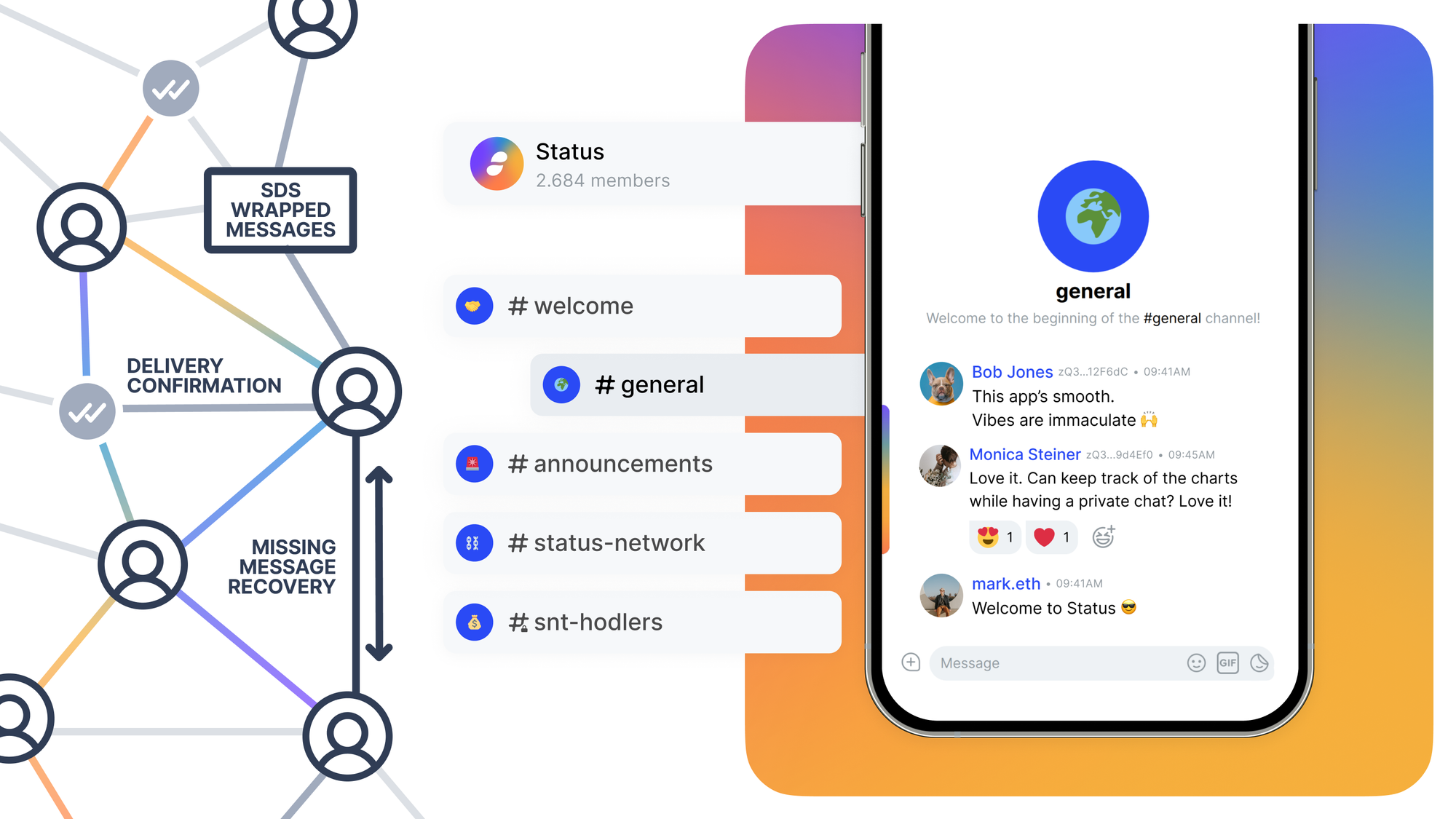
Delivery confirmation: Every message sent over the SDS protocol includes a compact record of which messages the sender has already received. When you get a message, Status checks that record to confirm whether your previous messages made it through. Think of it like the double-tick you see in traditional messengers, a simple signal that your message landed.
Missing message detection and recovery: Each message also carries references to earlier messages in the conversation. If your Status receives message C but has no record of message B, it knows something was missed and can go looking for it. Currently, message recovery happens by fetching the missing message from store nodes, which keep encrypted message envelopes for up to 30 days. In the future, this will be handled by SDS Repair, a peer-to-peer retransmission mechanism where other participants in the network resend the missing message on request.
Before SDS, delivery confirmation (the double-tick) only existed in direct and group chats in Status, thanks to a protocol called MVDS. Community channels had no equivalent. Messages could be missed with no way to detect or recover them.
With SDS integration, Status communities gain the same reliability features that direct and group chats have always had. Community members will be able to see whether their messages were received, and the app will be able to silently detect and fill in gaps in the conversation history, making community communication significantly more reliable, especially for larger groups on a decentralized network.
SDS is a breaking change, so it is being introduced gradually across three releases:
Status 2.37 (SDS rollout starts): The app now understands SDS messages when it receives them, but still sends messages in the old format. All users on 2.37 and above are ready to communicate with future versions.
Status 2.38: An intermediate release with additional groundwork. Message recovery will also be enabled in this version, allowing users on 2.38 to decode 2.39 wrapped messages and recover any missing ones when detected.
Status 2.39 (SDS rollout complete): The app will switch to sending SDS messages by default. This is the full activation of the SDS protocol in Status communities.
Important: Once Status 2.39 is released, users on version 2.36 or earlier will not be able to read messages from users on 2.39 and above. Upgrading to at least version 2.37 ensures full compatibility with the rest of the network.
Once SDS Repair ships in Q2-Q3 2026, missed messages will no longer depend on store nodes for recovery. Instead, other participants in the network will be able to resend missing messages directly on request, making message recovery more decentralized and resilient.